
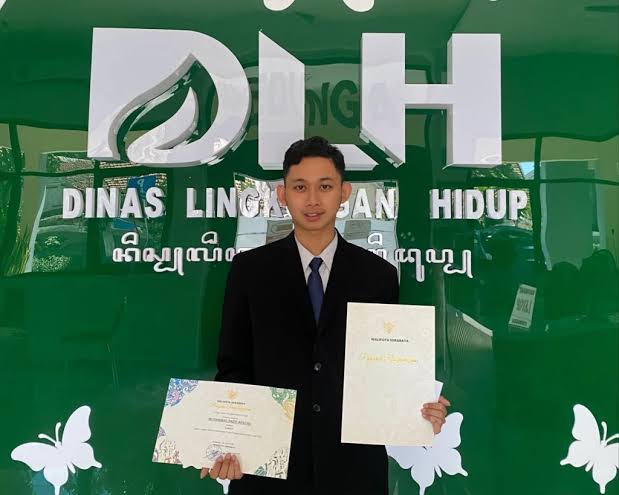
SURABAYA – Muhammad Razif Arsyad, a student of the D4 Tourism Destination Study Program, Faculty of Vocational Studies (FV), Universitas Airlangga (UNAIR), has won First Place in a national Creative Video Competition focusing on waste management, organized by the Surabaya City Environmental Agency in 2026.
The competition was open to participants from across Indonesia, with the judging and award ceremony held in Surabaya. Eight winners were selected, consisting of First, Second, and Third Place winners, along with five Favorite Award recipients. Razif, who is from Jepara, received his award from the Mayor of Surabaya on Tuesday (July 7, 2026).
Delivering a Waste Management Message Through Cinematic Storytelling
Razif’s winning video uses a cinematic storytelling approach to deliver its environmental message in a compelling and structured way. The video begins by portraying Surabaya as a clean city before presenting a contrasting situation in which the environment becomes polluted, waste accumulates, and rivers become contaminated.
The storyline then highlights the potential consequences of poor waste management, including water pollution, the potential spread of bacteria and germs to food consumed by the public, and disruptions to daily activities caused by plastic waste.
The video subsequently provides educational information on proper waste sorting, including the separation of organic, inorganic, and hazardous and toxic waste (B3).
At the end of the video, Razif encourages environmentally friendly habits in everyday life, such as carrying a reusable tumbler, bringing reusable shopping bags, and, most importantly, disposing of waste properly. Through the video, he emphasizes that protecting the environment and adopting an environmentally friendly lifestyle are essential for a sustainable future.
Overcoming Challenges During Production
Behind the finished work was a lengthy production process. Razif faced several challenges, beginning with finding suitable properties and filming locations, which required multiple shooting sessions.
Another challenge arose during the drone filming process. Razif had only recently learned how to operate a drone, requiring him to develop his skills while producing the video.
The editing and voice-over stages also presented difficulties. The editing equipment experienced lag, slowing down the production process, while the voice-over had to be carefully adjusted to match each scene and the message being conveyed.
Despite these challenges, Razif successfully completed the production and ultimately earned the top award in the competition.
Encouraging Students to Create with What They Have
Razif encouraged students interested in videography and creative competitions not to wait until they have professional equipment before starting to create.
“Make use of what you have, learn the basic techniques, and keep improving your skills through various small projects,” he said.
According to Razif, every stage of the creative process—from filming and editing to receiving feedback—is an important part of developing skills. His achievement demonstrates that limited equipment should not become a barrier to creativity and achievement.

Leave a Reply