
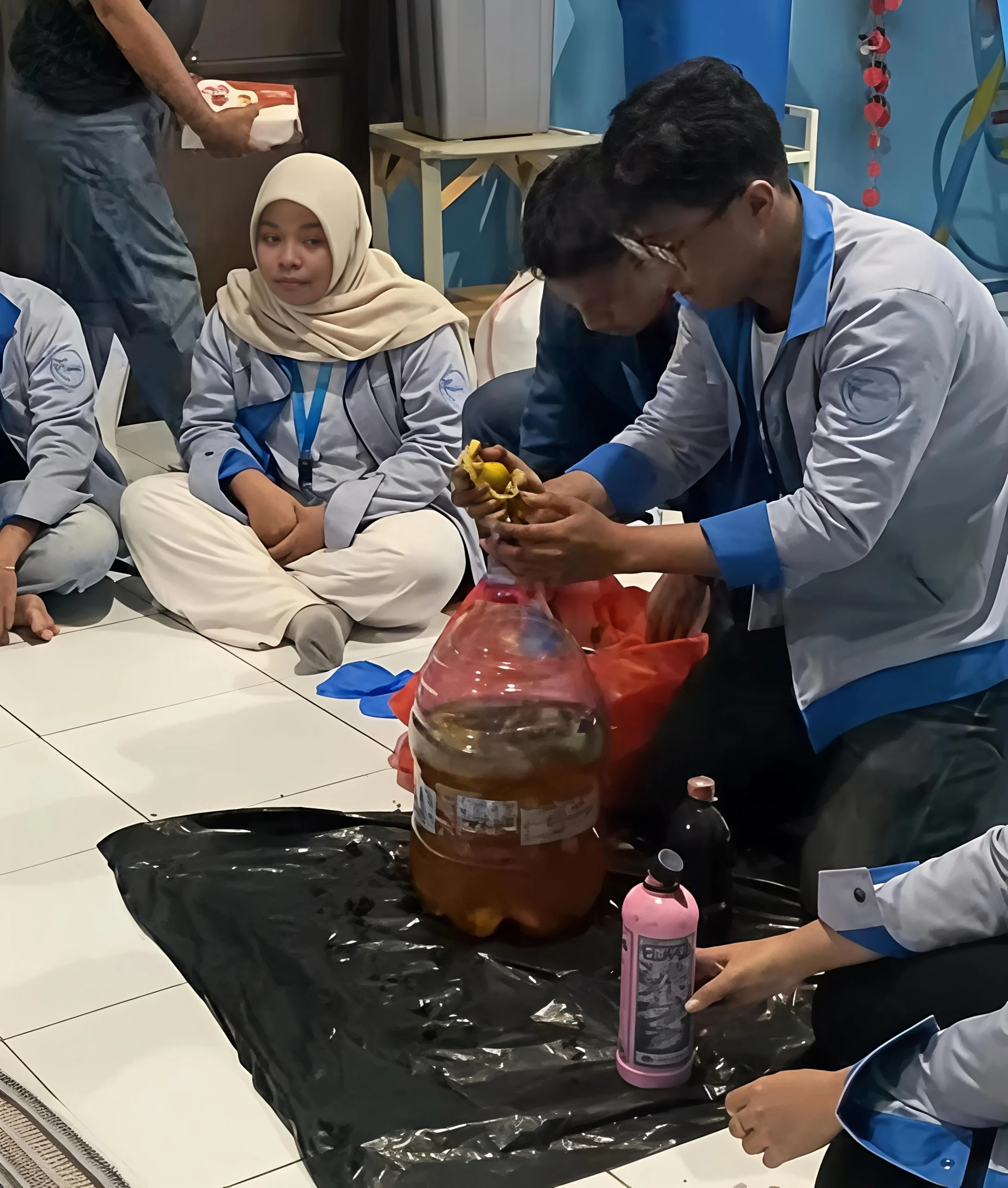
SURABAYA – Students from the Faculty of Fisheries and Marine Sciences (FPK) at Universitas Airlangga (UNAIR), through the Student Scientific Studies (KAKEMA), contributed to the NAPELI (Nanotechnology for Environmental Care) program by educating the community on the use of organic materials as an environmentally friendly alternative to pond fertilizer.
The educational activity was held on July 21, 2026, in Sumberejo Village, Gresik Regency. It aimed to improve participants’ understanding of organic waste management and its transformation into useful products that can support sustainable aquaculture practices.
Introducing Liquid Organic Fertilizer for Aquaculture Ponds
The educational session featured a team of KAKEMA FPK UNAIR speakers consisting of KAKEMA Chair Aditya Jayawardhana Ramadhani, along with Regita Aurelia Azzahra, Risa Ayu S., and Moch Birr Bik Maylandry.
During the session, the team introduced several methods for utilizing organic waste, including the production of liquid organic fertilizer (POC), eco-enzyme, and compost from dry leaves.
Participants were first introduced to the production of liquid organic fertilizer using organic materials such as dry leaves and compost. These materials are processed with water and combined with molasses and an activator solution to support fermentation.
The resulting fermented product can be used as an alternative pond fertilizer to provide nutrients to the water and support the growth of phytoplankton, which serves as natural food for fish.
“Through simple innovations based on natural materials, communities can contribute to sustainable aquaculture practices that align with the principles of a circular economy and environmental conservation,” said Aditya.
In addition to POC, participants also learned how to produce eco-enzyme using household organic waste, including fruit scraps, vegetables, and leaves. The materials are fermented using a mixture of water, molasses, and an activator solution to produce an organic solution that can support more sustainable environmental management.
Turning Dry Leaves into Simple Organic Compost
The KAKEMA team also introduced a simple method for directly utilizing dry leaves through a composting process using sacks. The method relies on natural decomposition to transform leaf waste into organic material that can benefit the aquaculture environment.
Through the activity, participants gained knowledge about the importance of organic waste management and the application of simple technologies to support fish farming productivity.
The use of organic fertilizer as an alternative to conventional pond fertilizer is expected to help create more productive aquatic conditions by increasing the availability of natural food sources, particularly phytoplankton.
Supporting the Sustainable Development Goals
The activity also contributed to the achievement of the Sustainable Development Goals (SDGs), particularly SDG 2 (Zero Hunger) through support for fisheries-based food production, SDG 6 (Clean Water and Sanitation) through sustainable aquatic environmental management, SDG 12 (Responsible Consumption and Production) through the conversion of organic waste into useful products, and SDG 14 (Life Below Water) through more environmentally friendly aquaculture practices.
Through collaboration between students and the community, KAKEMA FPK UNAIR continues to promote simple, science-based innovations that can be applied in everyday life while supporting the sustainable development of the fisheries sector.
Leave a Reply