
SURABAYA – Eight master’s students from the Human Resource Development (HRD) Study Program, Creative Industry specialization, at the Graduate School of Universitas Airlangga (UNAIR), initiated a Culinary Innovation for MSMEs workshop to strengthen the business and culinary skills of local food entrepreneurs.
The workshop was held on July 20, 2026, as part of a community partnership program focused on strengthening the business capacity of women entrepreneurs through production improvement and branding at Bu Ulfa’s food stall. The activity was also conducted as an alternative form of final examination assessment for the Fashion and Culinary Entrepreneurship course.
The eight students involved were Affan Ghaffar Ahmad, Andreas Fajar Nugroho, Ayuni Putri Kusuma, Haris Sofwanul Faqih, Hidayatul Fitriyani, Nadhefa Naufalillah, Rayhan Yoga, and Tiara Putri. In addition to working with Bu Ulfa as the main partner, the students also involved 14 other culinary MSME entrepreneurs from Surabaya to expand the program’s impact.
Developing Bakso Tewel from Local Ingredients
The workshop was held at the production kitchen of the Hotel Management program at UNAIR’s Faculty of Vocational Studies, Campus B. The students invited two culinary practitioners, Icus Affandi, a beverage specialist and owner of Syrup Yasmin, and Achmad Zainudin, a chef and lecturer in Hotel Management at UNAIR.
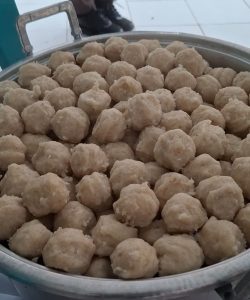
The training focused on helping participants reduce production costs while maintaining the taste and appearance of their products. One of the main innovations developed during the workshop was Bakso Tewel, a meatball product made from young jackfruit.
The students applied the DORA (Doing–Observation–Reflection–Action) method throughout the training. During the Doing stage, participants practiced preparing the food directly in the kitchen. The initial evaluation of Bakso Tewel showed positive results in terms of aroma, appearance, and texture.
The process continued with Observation and Reflection, during which participants tested the recipe independently at home. During the first food test on July 26, 2026, Bu Ulfa’s Bakso Tewel and other participants’ products were found to have a relatively soft texture. The participants then continued refining their recipes through the Action stage.
After several rounds of improvement, Bu Ulfa developed a denser and more flavorful Bakso Tewel formulation. The product was subsequently incorporated into new menu variations, including chicken noodles topped with chicken feet and Bakso Tewel, as well as capcay.
Business Understanding Rises to 91.33%
The effectiveness of the workshop was measured through participant evaluations. Their average understanding of business and culinary techniques increased from 50% in the pre-test to 91.33% in the post-test. The source reported an 82.67% increase in correct responses compared with the initial test results.
The results demonstrate how hands-on learning can provide participants with practical experience in developing culinary products and managing aspects of their businesses. The workshop also connected academic learning with real challenges faced by local MSME entrepreneurs.
Through the development of Bakso Tewel, the program showed how locally available food ingredients can be transformed into products with added value. The initiative also provided an opportunity for UNAIR graduate students to contribute their academic knowledge directly to the development of local culinary businesses.
The program highlights the potential of experience-based learning to support entrepreneurial development while strengthening collaboration between higher education institutions and the MSME sector.
Leave a Reply