
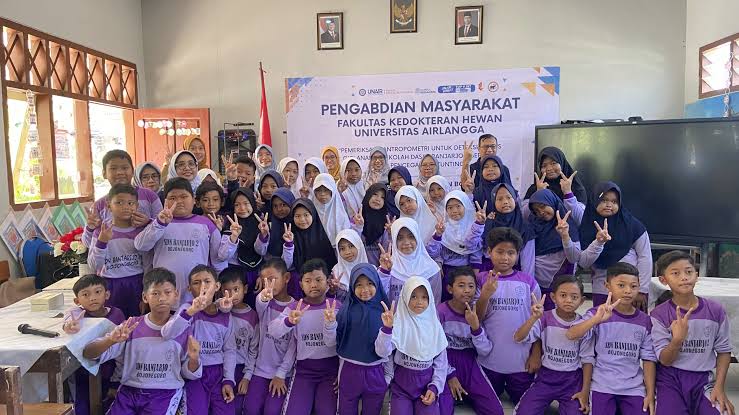
SURABAYA – The Faculty of Veterinary Medicine (FKH) at Universitas Airlangga (UNAIR) is strengthening efforts to detect growth disorders at an early stage by focusing on children in their pre-pubertal years. Through a sustainable community engagement program in Bojonegoro Regency, FKH UNAIR emphasized that monitoring children’s growth should continue beyond the first 1,000 days of life.
The program involved anthropometric examinations of 295 fourth-, fifth-, and sixth-grade elementary school students from eight schools in Bojonegoro on July 6, 2026. The activity involved collaboration between FKH, the Faculty of Medicine, and the Faculty of Vocational Studies at UNAIR, bringing together expertise to support more comprehensive examination and analysis.
The Importance of the Pre-Pubertal Stage
Prof. Dr. Widjiati, drh., M.Si., PAVet(K), the coordinator of the FKH UNAIR community engagement program, explained that the pre-pubertal period is an important stage for monitoring children’s growth.
At this stage, children still have opportunities to address nutritional needs if indications of growth disorders are identified. Early detection therefore allows appropriate follow-up before children enter adolescence.
“The pre-pubertal period is very important because it is a period of growth. If there are indications of stunting at this stage, nutritional needs can still be addressed. If we fail at this stage, we could lose a generation,” she explained.
During the examination, the team measured several anthropometric indicators, including height, body weight, head circumference, mid-upper arm circumference, waist circumference, and hip circumference.
Height-for-age and sex was used as the primary parameter for stunting screening, referring to growth charts developed by the World Health Organization (WHO) and the Centers for Disease Control and Prevention (CDC).
Data-Based Follow-Up for Children’s Nutrition
Following the examination, the collected data will be compiled and analyzed before being reported to the Bojonegoro Health Office, Education Office, and Regency Government.
The data is expected to provide a basis for developing more targeted strategies to address growth and nutritional issues among children in Bojonegoro. This approach also strengthens the role of universities in supporting evidence-based public health programs.
The school community has also continued to support students’ nutritional needs. Kiki Novandari, a homeroom teacher at SDN Banjarjo II, explained that teachers had received training from the Health Office regarding nutritious food, while the school canteen was routinely monitored to ensure that the food provided met health standards.
In addition, local community health centers conduct visits to schools every two months to monitor students’ health, including examinations related to stunting.
Strengthening Sustainable Stunting Prevention
The community engagement program reflects FKH UNAIR’s commitment to ensuring that stunting prevention does not stop at the first 1,000 days of life. Continuous monitoring during the school-age and pre-pubertal periods can help identify potential growth problems before children enter adolescence.
Through cross-disciplinary collaboration and data-based follow-up, FKH UNAIR hopes that stunting prevention efforts can become earlier, more targeted, and more sustainable, ultimately supporting the development of a healthier and higher-quality generation.



Leave a Reply